
- May 5, 2025
Tai Chi vs Qi Gong: What’s the Difference and Which One Is Right for You?
- Wellness Academy Team
- 0 comments
You’ve probably heard of both Tai Chi and Qi Gong — usually in the same breath. They look similar at first: slow, intentional movements, flowing breath, calm focus. But once you get into the practice, the difference becomes clear. And it matters.
If you’re trying to figure out which one makes sense for you — your age, your body, your lifestyle — let’s break it down in the simplest way possible: not through tradition or theory, but through the real-life benefits and how these practices actually feel.
Let’s Talk Tai Chi First: This Is the Practice for Aging Well

If you’re in your 60s or older — or you’re caring for someone who is — Tai Chi might be the single best practice they can do. That’s not a bold claim, it’s just what I’ve seen play out again and again.
1. Tai Chi helps prevent falls — and that’s everything
Here’s the truth: a fall changes everything. I’ve seen it firsthand. One fall led to a fractured hip… which led to immobility… which led to fear of walking again. And from there, confidence and strength just drained away.
Tai Chi can help break that cycle before it starts. The slow, weight-shifting movements train balance in the most natural way possible. You learn how to move with awareness — how to transition from foot to foot with control. Not just standing still, but moving safely.
That’s powerful.
If that sounds like something you or a loved one could benefit from, our Tai Chi: The Art of Moving Meditation course is a great place to start. It’s gentle, clear, and designed for all experience levels.
2. It supports joints, especially if arthritis is an issue
One in three older adults deals with osteoarthritis — stiff knees, hips, shoulders that just don’t move like they used to. Tai Chi isn’t about forcing anything. The movements spiral, flow, and create mobility without strain.
You’re not pushing through pain. You’re coaxing the joints to move again, softly and steadily. Over time, this can make a huge difference in comfort and range of motion — especially if you practice consistently, even for just 15–20 minutes a day.
3. It keeps the brain engaged
Tai Chi isn't just for the body — it's also amazing for the brain. Learning and remembering movement sequences challenges your memory, attention, and coordination. Add in the fact that it’s a form of physical activity (which on its own boosts brain health), and you’ve got a double benefit.
It’s one of the few practices that combines mental stimulation and physical movement in a way that’s sustainable and supportive — especially as we age.
Now, What About Qi Gong? Think of It as a Movement Toolkit for Every Season of Life

If Tai Chi is a structured form that teaches balance, control, and flow — Qi Gong is the open-ended toolbox. And that’s part of its magic.
There isn’t one set style of Qi Gong. Instead, it’s a massive collection of practices that span everything from physical healing to energy cultivation, stress regulation, emotional release, and light movement meditation.
So the real question becomes: what do you need right now?
Looking to unwind?
Qi Gong excels at this. There are specific sequences designed purely to calm the nervous system, regulate breathing, and help you let go of stress. Qi Gong for Stress Relief is one of our most popular offerings for this reason. It’s restorative, easy on the body, and deeply grounding.
Dealing with chronic pain or stiffness?
Again — this is where Qi Gong really shines. Because it’s breath-connected, body-aware, and completely non-aggressive, you can use it to release pain rather than fight through it. Our Qi Gong for Upper Back Pain is a perfect example — it’s not about pushing limits, it’s about unlocking what’s been stuck.
Need a lighter form of movement that still supports your wellness goals?
Many people looking for energy flow, circulation, and light activation — without “working out” in the traditional sense — find their rhythm in Qi Gong for Weight Loss. It’s not about counting reps or calories. It’s about reconnecting with your body in a way that supports healthy function and flow.
How Does Qi Gong Feel Different from Tai Chi?
Let’s talk about the actual experience on the mat or in the room.
Tai Chi moves in longer sequences — it’s like learning a dance or a form. You move through patterns that build over time.
Qi Gong, on the other hand, can be as simple as repeating one motion slowly for five minutes, in sync with your breath. It’s less about choreography and more about presence.
Qi Gong feels:
Softer
More internal
More flexible to where your body and mood are at that moment
It’s meditative, yes — but it can also be energizing, clearing, deeply restorative, or even a little playful depending on the set you’re doing.
And the best part? It’s for everyone — no matter your age, background, or condition. That’s not marketing. That’s the design of the practice itself.
If you’re curious where to begin, our general Qi Gong course is a gentle, versatile way to explore the basics.
Related Resource
You can also browse all our programs on the Holistic Wellness Online Courses page if you’re looking to explore breathwork, mindfulness, or body-based healing from different angles.
Tai Chi vs Qi Gong: So Which One Should You Start With?
By now you probably get it: both Tai Chi and Qi Gong are valuable. But that doesn’t mean they’re interchangeable. Each one has a slightly different feel, structure, and effect — and depending on your goals, one may make more sense to begin with.
Here’s how to figure that out.
You Might Want to Start with Tai Chi If…
You're over 60 and looking for a sustainable practice that supports your balance, strength, and coordination
You're dealing with arthritis or joint stiffness and want movement that keeps you mobile without making things worse
You prefer something structured — with sequences and flow that give you a sense of progress
You’re interested in movement that feels both mentally and physically engaging
Tai Chi is a full-body practice that builds from the ground up. It’s great for confidence, stability, and gently rewiring the connection between body and brain. And because it moves slowly and intentionally, there’s room to really learn at your own pace.
If this sounds like what you need, we recommend starting with Tai Chi: The Art of Moving Meditation — a course designed for everyday people, not performers.
You Might Want to Start with Qi Gong If…
You’re managing stress, tension, or anxiety and want something that calms the nervous system
You need something gentle, adaptable, and forgiving — especially if you’re recovering from injury or dealing with chronic pain
You want to feel more connected to your body and breath, but you’re not quite ready for complex movement
You’re looking for a toolbox of short, focused practices you can mix into your daily routine
Qi Gong has no pressure to “keep up.” You move with your breath. You stay where your body feels safe. You focus on quality, not quantity. Whether you’re recovering from burnout, trying to soften pain, or just want a calm daily reset, this might be the right path.
You can begin with our foundational Qi Gong course, or explore something more specific like:
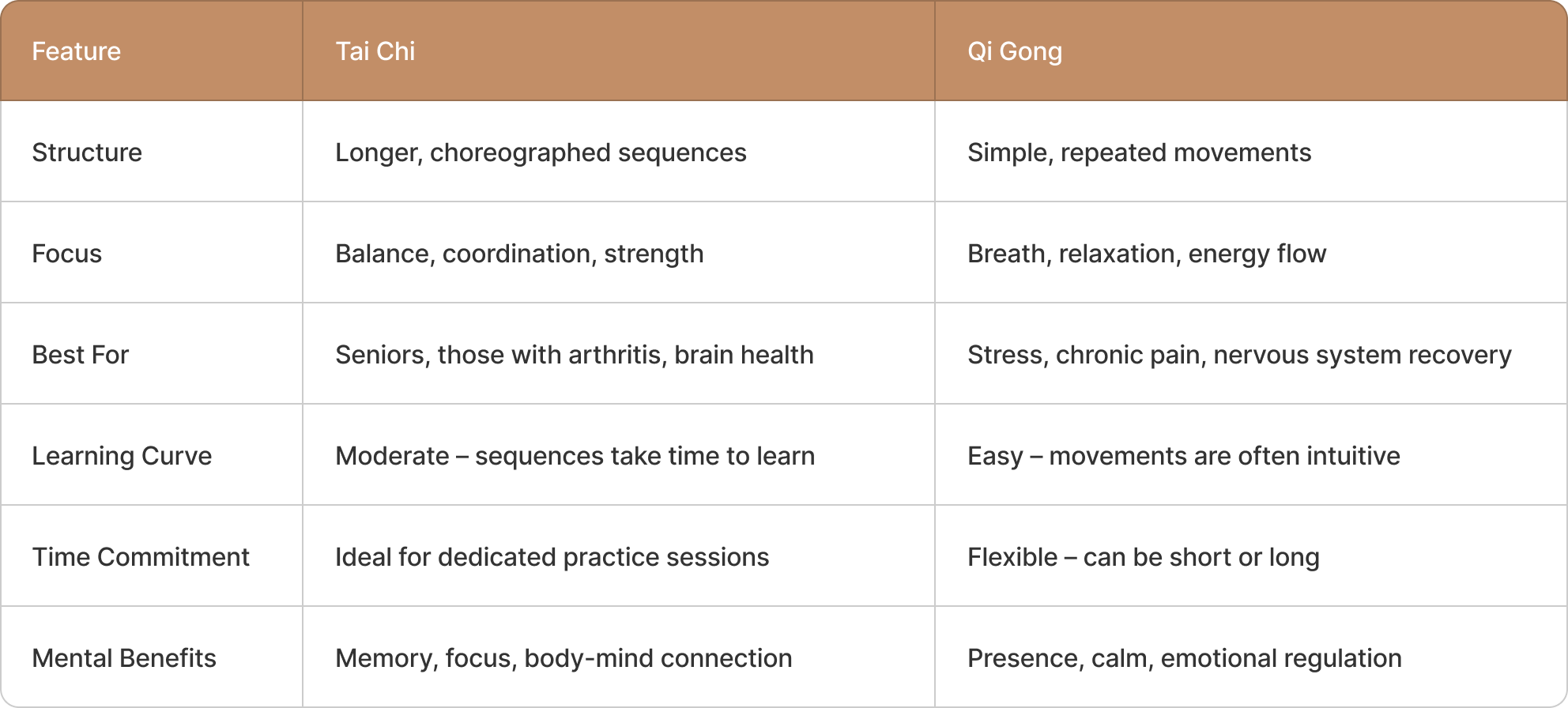
Quick Side-by-Side: Tai Chi vs Qi Gong
Can You Do Both?
Absolutely. In fact, many people do. Some days call for a more structured, focused Tai Chi session. Other days, you might just want to stand, breathe, and move gently through a Qi Gong flow.
The good news is: there’s no wrong way to approach this. These aren’t competing practices — they’re complementary tools that you can use depending on what your body and mind need that day.
Where to Start
If you’re new to this world, the best thing you can do is just begin somewhere — with something that feels doable. Explore, feel it out, and let your body guide what comes next.
Here are some next steps based on your goals:
Want to build structure, balance, and cognitive strength?
Start with Tai Chi: The Art of Moving Meditation
Need calm, release, and gentle body-based healing?
Explore our Qi Gong Course or the more targeted options like:
Or browse our full Holistic Wellness Online Courses collection to see what else feels aligned.