What Is Wheelchair Taijiquan?
Wheelchair Taijiquan — also called wheelchair Tai Chi or adaptive Tai Chi — is a form of the traditional Chinese practice specifically designed for people who use wheelchairs or have significant lower-body limitations.
It was developed in its most systematic form by Dr. Zibin Guo, a medical anthropologist and Tai Chi master at the University of Tennessee Chattanooga, whose work created a 13-posture wheelchair Tai Chi sequence that adheres to the fundamental principles of traditional Taijiquan — slow, continuous movement; internal focus; coordinated breathing; relaxation — while being fully performable from a seated position.
The result is not a diminished version of Tai Chi. It is a complete practice. The upper body, arms, and trunk generate the circular, flowing movements that characterise Taijiquan. The breath, the mental focus, and the internal quality of the movements remain entirely intact.
Who It's For
Wheelchair Taijiquan was developed for people with ambulatory impairment — those who use wheelchairs full-time or who cannot practise standing Tai Chi safely. It has been successfully used with people managing:
Spinal cord injuries — both complete and incomplete. Stroke and post-stroke rehabilitation. Multiple sclerosis and other neurological conditions. Parkinson's disease. Severe arthritis and joint conditions. Amputations. Advanced age with significant mobility limitations.
Studies have documented improvements in hand and arm function, sitting balance, mental health, and quality of life after just 8–12 weeks of consistent practice.
How It Differs from Chair Tai Chi for Seniors
It's worth drawing a distinction here, because the two are often confused.
Chair Tai Chi for seniors — a practice that has surged in popularity in 2026 — typically involves standing Tai Chi practitioners sitting in a chair as a modification. The movements are designed with standing in mind, and the chair is an accommodation.
Wheelchair Taijiquan is designed from the ground up for the seated body. The 13-posture sequence created by Dr. Guo is choreographed specifically for the ranges of motion available to wheelchair users, with no standing version underlying it. It is a primary practice, not an adaptation.
This distinction matters for anyone who has tried generic seated Tai Chi and found the movements awkward, unstable, or poorly suited to their actual physical situation.
The 13 Postures: What They Work
Dr. Guo's wheelchair Taijiquan sequence moves through the upper body systematically, addressing the areas of greatest functional importance for wheelchair users.
Opening and closing movementsSlow, expansive arm movements that open the chest, stimulate the Lung meridian, and establish the breathing rhythm for the practice. These are the same opening movements used in standing Yang-style Tai Chi, performed with the same quality of relaxed, unhurried expansion.
Ward Off, Roll Back, Press, PushThe four classic Tai Chi energies — Peng, Lu, Ji, An — adapted for the seated body. These movements develop the circular, continuous quality that is the hallmark of Taijiquan. The arms trace large, flowing circles while the trunk rotates and the breath coordinates with the direction of movement.
Single WhipOne arm extends outward in a "hook hand" while the other pushes away — a movement that stretches the chest, strengthens the shoulder rotators, and develops the differentiation between the two sides of the body that is fundamental to Tai Chi.
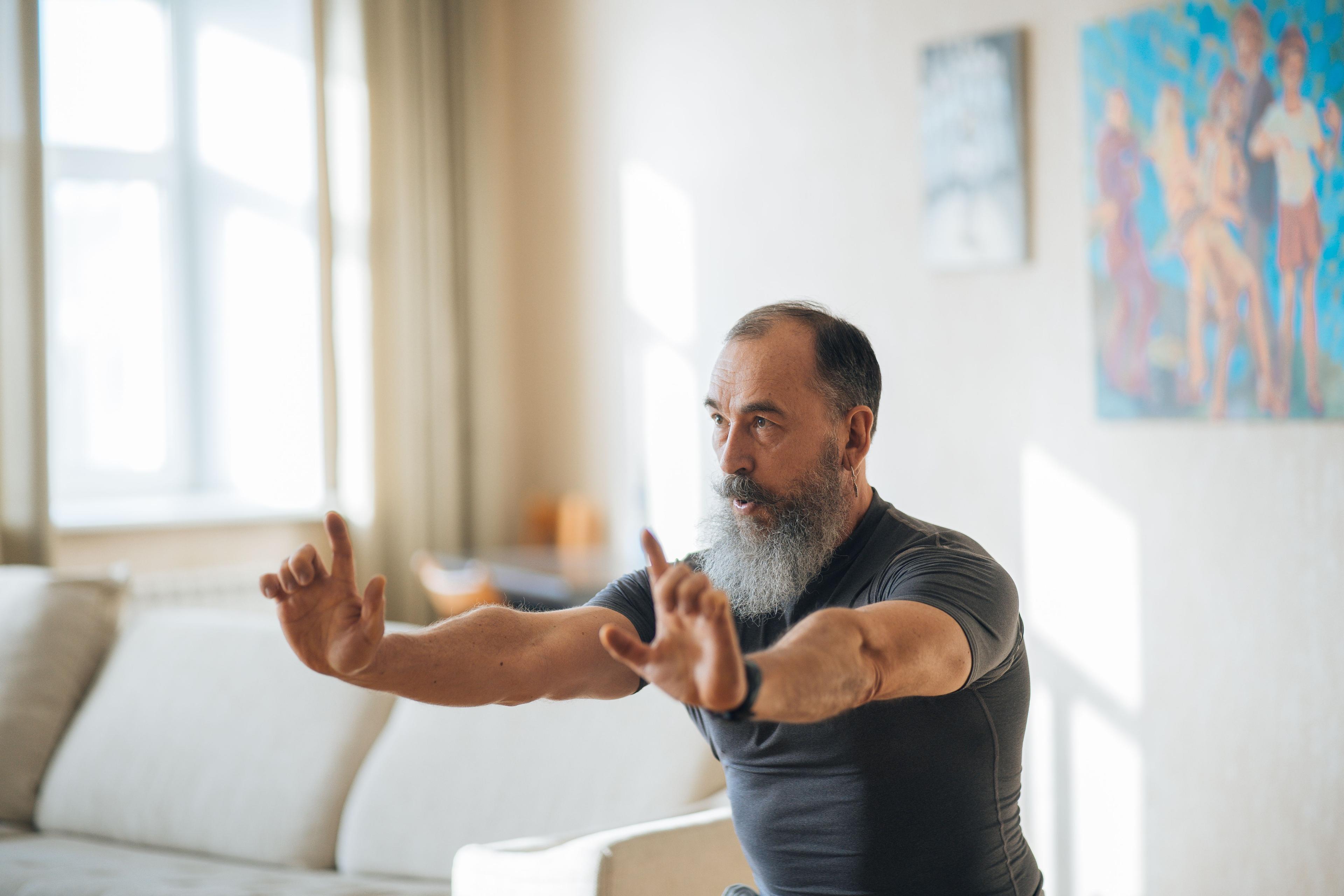
Wave Hands Like CloudsSlow, continuous lateral arm movements that cross and uncross in front of the body. This movement is particularly effective for shoulder mobility, spinal rotation, and the development of coordinated, smooth motion between the arms and trunk.
Brush Knee and Twist Step (seated adaptation)One hand sweeps downward and to the side while the other pushes forward — in the seated version, this becomes a trunk rotation with an asymmetric arm movement that works the obliques and builds rotational stability in the core.
Closing formSlow, settling movements that bring the arms down and inward, coordinated with long exhalations. The practice closes as it opened — with an emphasis on stillness, breath, and internal quiet.
If you'd like a complete holistic health programme built for wheelchair users — covering Tai Chi, Qigong, breathwork, sleep, and nutrition — we have a free course — Chair Wellness: Holistic Health for Wheelchairs Users.
The Evidence Base
Research on wheelchair Taijiquan is small but consistent in its findings.
A randomised controlled trial published in Complementary Therapies in Clinical Practice found that wheelchair users who practised seated Tai Chi twice weekly for 12 weeks scored significantly lower on depression scales, higher on quality of life measures, and showed improved sitting balance compared to a control group.
A separate study in stroke rehabilitation found that seated Tai Chi practised in the early post-stroke period improved hand and arm function, sitting balance, and mental health outcomes — and was the first randomised controlled trial to show that seated Tai Chi in the early phase after stroke enhanced health outcomes.
Research from Spring Forest Qigong found that seated Qigong practice in adults with spinal cord injury produced meaningful reductions in neuropathic pain and improvements in SCI-related symptoms that persisted for weeks after the intervention.
Starting Wheelchair Taijiquan at Home
The best starting point is a guided programme rather than individual videos. The reason is sequence: Tai Chi movements build on each other, and learning them in the correct order — with an understanding of the breathing and internal focus that makes them Tai Chi rather than just arm exercises — produces far better results than learning postures in isolation.
A few practical notes for starting at home:
Chair stability matters. For manual wheelchair users, engage the brakes before beginning any practice. For power wheelchair users, ensure the chair is stable and the armrests are positioned so they don't interfere with arm movements.
Start with the opening movements only. The first three postures of any Tai Chi sequence contain the essential qualities of the whole practice — relaxation, coordinated breathing, and smooth, unhurried movement. Spending two weeks on just the opening before moving on will accelerate learning of the whole sequence.
Focus on quality, not quantity. Ten minutes of genuinely slow, relaxed movement produces more benefit than 30 minutes of rushed movement. The speed of Tai Chi is slower than most people expect.
For more on how Chinese practices support the whole body from a seated position — including breathwork and self-massage alongside movement — see our posts on Qigong for multiple sclerosis and seated breathwork for wheelchair users.
Wheelchair Taijiquan and Lymphatic Health
People who use wheelchairs are at higher risk of lymphatic stagnation — the reduced movement of lymph fluid through the body that leads to swelling, immune suppression, and reduced tissue health.
The lymphatic system has no pump. It depends entirely on the compression and release of surrounding tissue through movement and breathing. Wheelchair Taijiquan provides both: the slow arm movements compress and release the lymph vessels along the arms and chest, while the deep, coordinated breathing drives the thoracic duct — the body's main lymphatic channel — far more effectively than shallow chest breathing.
This is one of the reasons practitioners often notice reduced swelling in the hands and arms after regular practice, alongside the more widely reported benefits for mood and function.
Frequently Asked Questions
Do I need to know traditional Tai Chi first?
No. Wheelchair Taijiquan is designed to be learned as a first practice, with no prior knowledge of standing Tai Chi required. In some ways it is easier to learn than standing Tai Chi, because there is no need to manage standing balance while simultaneously learning the movements.
Can it be practised in a power wheelchair?
Yes. The movements are performed from a stable seated position and do not require the practitioner to propel or manage the wheelchair during practice. Power wheelchair users typically find it as accessible as manual wheelchair users.
How long before I notice a difference?
Most people notice changes in mood and sleep quality within the first two to three weeks. Physical changes — improved arm and shoulder mobility, reduced upper-body tension, better sitting balance — typically emerge over 4–8 weeks of consistent practice. The improvements are gradual and cumulative.
Is wheelchair Taijiquan suitable during rehabilitation after a stroke or surgery?
It has been studied specifically in post-stroke rehabilitation with positive results. Any rehabilitation exercise should be cleared with your medical team first, particularly in the acute phase. Many rehabilitation programmes now include wheelchair Taijiquan as a complement to conventional physiotherapy.
Where can I learn wheelchair Taijiquan?
Our Chair Wellness course is a 73-lesson holistic health programme built for wheelchair users. Alongside seated Tai Chi and Qigong, it covers breathwork, sleep, brain health, nutrition, and psychological wellbeing — all from a wheelchair, all self-paced, and free to access.