What Is Sarcopenia and Why Does It Matter for Falls?
Sarcopenia is the gradual, age-related loss of muscle mass, strength, and function. It begins earlier than most people realise — muscle mass typically starts declining in our 30s, accelerates after 50, and by 80 many people have lost up to 50% of the muscle mass they had at their peak.
The connection to falls is direct. Muscle weakness — particularly in the legs and core — is one of the leading risk factors for falls in older adults. When the muscles that stabilise our joints and control our balance cannot respond quickly enough to a sudden shift in weight, we fall. Sarcopenia makes that threshold lower, and the consequences of crossing it more serious.
A 2026 review in Natural News described sarcopenia as "the silent threat" — a condition that progresses without obvious symptoms until a fall, a fracture, or a sudden loss of function makes it undeniable. The same review noted that sarcopenia-related complications now account for a significant proportion of hospitalisations in adults over 65.
The good news is that sarcopenia is not inevitable. The right kind of movement can slow its progression, preserve functional strength, and — in many cases — reverse significant losses even in people in their 70s and 80s.
Why Conventional Exercise Advice Often Misses the Mark
The standard recommendation for sarcopenia is resistance training — lifting weights or using resistance bands to load the muscles and stimulate growth. This is evidence-based and effective. But it also creates a barrier for many older adults, particularly those who are already experiencing weakness, joint pain, or balance problems.
Heavy resistance training requires a level of physical confidence and joint integrity that not everyone over 60 has. It also does nothing to address the balance, proprioceptive awareness, and movement coordination that determine whether muscle strength actually translates into fall prevention.
You can be relatively strong and still fall — if the muscles don't activate in the right sequence, at the right moment, in response to the right stimulus. This is where Tai Chi and Qigong offer something that conventional resistance training does not.
How Tai Chi and Qigong Address Sarcopenia
Tai Chi and Qigong are not conventionally thought of as strength-building practices. But their effect on the specific type of muscle function most relevant to fall prevention is well-documented.
Eccentric and isometric loadingMany Tai Chi movements require holding a semi-squat position or slowly lowering and rising through the legs. This produces eccentric (lengthening under load) and isometric (static) muscle contractions — particularly in the quadriceps, gluteals, and hip stabilisers. These are exactly the muscles most affected by sarcopenia and most important for fall prevention. Clinically, leg press strength in these muscle groups is one of the strongest predictors of fall risk.
Neuromuscular coordinationSarcopenia affects not just the volume of muscle but its quality — specifically the speed and precision with which the nervous system activates muscle fibres in response to a sudden demand. This neuromuscular dimension is what determines whether we catch ourselves when we start to fall. Tai Chi, with its continuous weight shifting and requirement for precise, controlled movement, trains this response directly. Studies consistently show improvements in reactive balance — the ability to recover from an unexpected perturbation — after Tai Chi practice.
Proprioceptive awarenessProprioception — the sense of where the body is in space — declines with age and is significantly impaired in sarcopenia. Tai Chi's slow, mindful movements, with attention directed to the sensations in the feet, ankles, and legs, rebuild proprioceptive sensitivity over time. This is one of the most important and overlooked aspects of fall prevention.
Hip and ankle strategyWhen we lose balance, the body uses one of two strategies to recover: a hip strategy (shifting the hips to bring the centre of gravity back over the feet) or an ankle strategy (subtle adjustments at the ankle). Both depend on the rapid activation of specific muscle groups. Tai Chi trains both strategies through its constant, gradual weight shifts and postural adjustments.
If you'd like a guided programme for balance and fall prevention, we have a free course — Fall Prevention & Better Balance.
What the Research Shows
A telerehabiliation study published by ClinicalTrials.gov in 2024–2026 specifically examined Tai Chi exercise for elderly adults with sarcopenia and found significant improvements in muscle function, balance, and quality of life. The intervention involved twice-weekly Tai Chi sessions over 12 weeks.
Earlier meta-analyses have shown that Tai Chi reduces fall incidence by 20–45% in older adults at risk — a larger effect than most pharmaceutical interventions. The mechanism includes both the direct strengthening of fall-critical muscle groups and the neuromuscular and proprioceptive improvements described above.
Qigong, which shares the same foundational principles as Tai Chi but with a greater emphasis on breathwork and self-massage, produces similar benefits in older adults who are not yet ready for the more dynamic demands of Tai Chi forms practice.
A Practical Qigong Routine for Muscle Health and Balance After 50
The following routine combines Qigong principles with the specific movement patterns most effective for preserving muscle function and improving balance. It takes approximately 15 minutes and can be done daily.
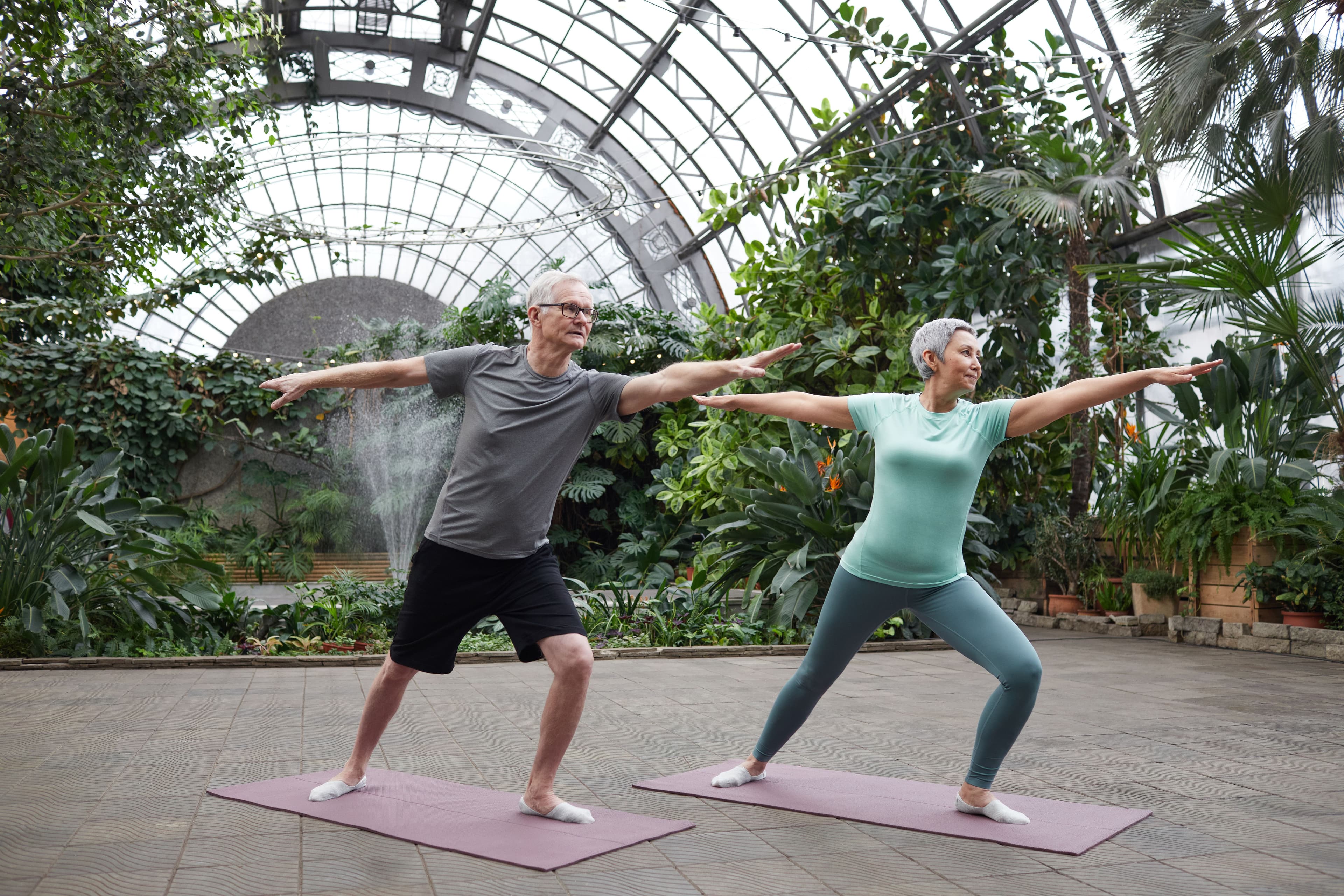
Horse stance breathing (3 minutes). Stand with feet wider than shoulder-width, toes turned slightly outward. Bend the knees into a comfortable partial squat — not deep, just enough to feel the thighs working. Hold this position and breathe deeply: inhale for 4 counts, exhale for 6. This is a low-load isometric exercise for the quadriceps, gluteals, and hip stabilisers — the exact muscles most vulnerable to sarcopenia.
Cloud hands (5 minutes). From a relaxed standing position, slowly shift weight from one foot to the other while the arms trace a figure-eight pattern. Focus on the sensations in the ankles and feet as the weight shifts. Move as slowly as possible. This exercise trains weight shifting, proprioception, and hip stability simultaneously.
Single-leg rooting (3 minutes). Slowly shift all your weight onto one foot and hold for 5–10 seconds before shifting to the other. Use a wall or chair for support if needed. As strength and confidence improve, reduce the support and extend the hold time. This directly trains the single-leg balance required during walking and stair descent.
Closing breathwork (4 minutes). Stand in a relaxed position and breathe deeply, allowing the body to settle. Visualise drawing energy up from the earth through the feet on each inhale. This practice, drawn from Qigong tradition, helps regulate the nervous system after movement and supports recovery.
Nutrition and Sarcopenia: What to Know
Movement alone is not sufficient to address sarcopenia. Protein intake is equally important — the muscles cannot repair and rebuild without adequate raw material. A 2026 meta-analysis of 248 studies concluded that older adults need approximately 0.4–0.5 grams of protein per pound of body weight daily to mitigate muscle loss. For a 70kg person, that is roughly 60–75 grams of protein per day.
Vitamin D is also important — deficiency impairs muscle function significantly, and 2026 research found that supplementation of 800 IU or more daily improved muscle function in deficient individuals. Many older adults in the UK are deficient, particularly in winter months.
For more on building a holistic approach to health after 50, see our post on body changes after 40 and what to do.
Frequently Asked Questions
Can you reverse sarcopenia at 70 or 80?
Yes. Multiple studies have demonstrated meaningful improvements in muscle mass and function in adults in their 70s, 80s, and even 90s with consistent exercise and adequate protein intake. The body retains the capacity for muscle adaptation throughout life — it simply requires a longer stimulus to achieve the same response as in younger adults.
Is Tai Chi enough on its own to prevent muscle loss?
Tai Chi is effective for the neuromuscular, balance, and functional strength dimensions of sarcopenia prevention. For maximum effect, it is best combined with some form of resistance training and adequate protein intake. However, for older adults who cannot or do not wish to do conventional resistance training, Tai Chi provides significant protection — particularly against the fall risk that sarcopenia creates.
How often should I practise to see results?
Three to five sessions per week of 15–30 minutes produces measurable improvements in balance and functional strength within 8–12 weeks. Daily practice of even 10 minutes is more effective than longer, infrequent sessions.
What is the best course for someone concerned about muscle loss and falls?
Our Fall Prevention for Seniors course covers the balance, stability, and Tai Chi practices most directly relevant to sarcopenia and fall risk. For a broader programme that also covers nutrition, sleep, and cognitive health, our Senior Wellness Programme addresses all six pillars of health after 50.