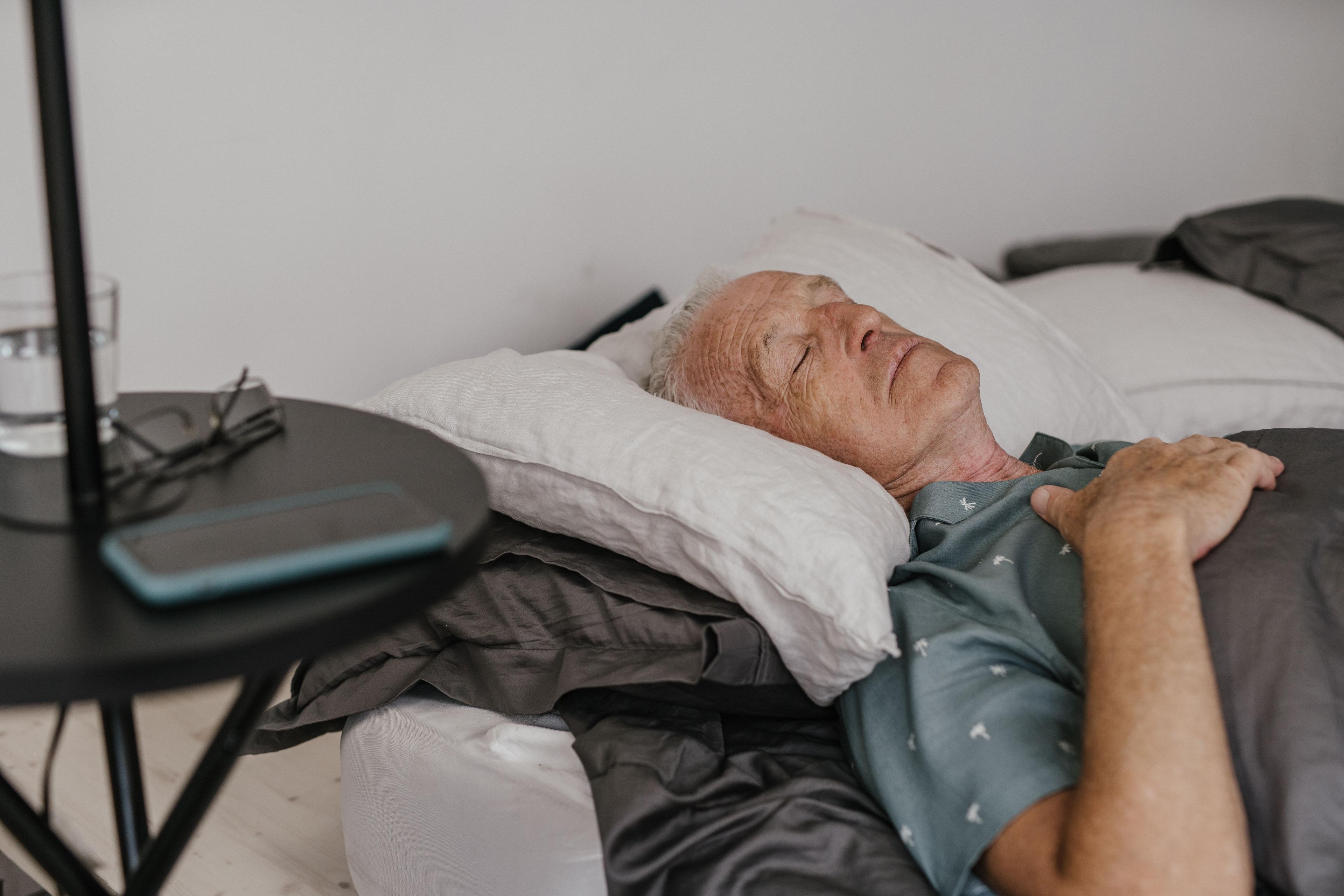
You fall asleep without much trouble. Then, sometime around 3am, you're wide awake. The room is dark and quiet, your partner is sleeping soundly, but your mind has switched on and your body feels oddly alert — almost wired. You lie there, watching the clock, knowing you need to sleep but unable to get there. By the time morning comes, you're exhausted.
If this is familiar, you are not alone. Waking in the early hours of the morning is one of the most common sleep complaints in adults over 60 — and it has very specific physiological causes. It is not simply a symptom of getting older that must be accepted. It is a pattern rooted in changes to cortisol, deep sleep architecture, and circadian rhythm — and it is a pattern that Qigong and Tai Chi are particularly well placed to address.
Why Sleep Changes After 60
Sleep in older adults is not broken — it is different. But understanding how it is different helps explain why the 3am wake feels so reliable, and why it responds to specific interventions.
Deep sleep declines with ageThe deepest and most restorative stage of sleep — known as slow-wave sleep, or N3 — naturally decreases as we age. In younger adults, N3 sleep makes up roughly 20% of total sleep time. By the time most people reach their sixties, it has often dropped below 10%. This matters because N3 is the phase in which the body carries out most of its physical repair, immune regulation, and memory consolidation. Less N3 means lighter, more fragmented sleep overall — and a greater likelihood of waking from minor disruptions that younger sleepers would sleep through.
The circadian rhythm shifts earlierThe body's internal clock — the circadian rhythm — tends to advance with age. This means older adults often feel genuinely tired earlier in the evening and naturally wake earlier in the morning. The body is not malfunctioning; it is operating on a shifted schedule. The difficulty is that most people's social and domestic lives are still calibrated to an earlier generation's timetable, so the mismatch between biology and routine can be significant.
Cortisol rises too earlyCortisol — the body's primary alerting hormone — follows a daily rhythm. It rises steeply in the early morning hours to prepare the body for waking, peaks within the first hour after sunrise, and gradually declines through the day. In older adults, this cortisol rise often begins earlier than it should, sometimes as early as 2 or 3am. When cortisol rises while the body still needs sleep, it triggers wakefulness — not from anxiety or noise, but from pure biochemistry. This is why the 3am wake so often feels like being abruptly switched on rather than gradually roused.
Melatonin production dropsMelatonin, which signals to the body that it is time to sleep, is produced in lower quantities as we age. The evening rise in melatonin becomes smaller and later, making it harder to consolidate sleep in the second half of the night. The combined effect of reduced melatonin and earlier cortisol creates a window of biological vulnerability in the small hours — which is precisely when most older adults find themselves awake.
None of this is a character flaw or a sign that something has gone wrong with you personally. It is biology. But biology can be influenced.
Why Medication Is Not the Full Answer
Many people who struggle with sleep in their sixties are offered, or consider, sleeping medication. For short-term or crisis situations, medication can provide real relief. But it is worth understanding why it is not a complete solution — and why so many older adults are actively looking for an alternative or a complement.
Most sleeping pills — including benzodiazepines and the newer non-benzodiazepine hypnotics — work by suppressing nervous system activity broadly. The result is sedation, which is not the same as natural sleep. Research has shown that sedative hypnotics actually suppress N3 deep sleep over time, which means the medication may help you stay unconscious but does not address the underlying deficit in restorative sleep that is driving the problem.
More fundamentally, medication does not address the cortisol dysregulation and circadian disruption that underlie the 3am waking pattern. When the medication is stopped, the pattern typically returns unchanged — and sometimes rebounds more acutely. For adults who want to sleep better without long-term pharmaceutical dependence, or who want something that works alongside existing medication, evidence-based movement practices offer a genuinely different mechanism of action.
How Qigong and Tai Chi Help Sleep
Deep sleep enhancementThe most compelling evidence comes from a 2026 randomised controlled trial that measured the effects of Tai Chi on sleep architecture using objective EEG monitoring — not just self-report. Adults aged 65 to 75 who practised Tai Chi for 12 weeks showed a 23.1% increase in N3 deep sleep, measured objectively by EEG. This is a significant result. It means Tai Chi does not simply help people feel like they slept better — it measurably increases the proportion of time spent in the most restorative sleep stage. For older adults whose N3 has declined with age, this represents a direct address of the underlying deficit.
Cortisol regulationSlow, rhythmic movement combined with mindful breathwork has a well-documented effect on the hypothalamic-pituitary-adrenal (HPA) axis — the system that regulates cortisol. Regular Qigong and Tai Chi practise reduces evening cortisol levels and blunts the abnormally early cortisol rise that triggers 3am waking. This is not a temporary effect; with consistent practise, the cortisol curve begins to normalise. The body learns, gradually, to hold its alerting response until the appropriate time.
Nervous system downregulationOne of the defining features of Qigong and Tai Chi is the emphasis on slow, diaphragmatic breathing coordinated with gentle movement. Extended exhalation — breathing out longer than you breathe in — directly activates the parasympathetic nervous system, which is the physiological opposite of the stress response. Regular practise shifts the autonomic nervous system towards parasympathetic dominance over time, reducing baseline arousal and making it easier for the body to stay in the lighter stages of sleep rather than surfacing into wakefulness.
Morning practice and the circadian anchorThere is a less obvious but important mechanism: a consistent morning movement practice helps regulate the circadian rhythm by providing a reliable biological signal at the same time each day. The body uses light, temperature, and physical activity as cues for its internal clock. A morning Qigong session — especially one that includes breathwork and gentle movement — sends a clear signal that anchors the body's sleep-wake cycle. The downstream effect is that the body becomes more predictable in its timing by evening, and sleep onset becomes easier.
You can also read more about how Tai Chi supports brain health and mental clarity and how the body changes after 50 and what helps.
If you would like a free guided morning practice that blends movement, breathwork, and NSDR meditation — specifically designed to restore the nervous system and support deeper sleep — our Morning Energy Flow course is a good place to start.
If you'd like to try the morning Qigong practice — including the NSDR meditation that supports deeper sleep at night — we have a free course — Morning Energy Flow.
An Evening Qigong Wind-Down Practice
The following practices are designed to be done in the 30 to 60 minutes before bed. They work by reducing cortisol, activating the parasympathetic nervous system, and signalling to the body that the transition to sleep is beginning. Done consistently, they help reduce the frequency and duration of 3am waking.
1. Slow spinal sway (5 minutes)Stand with feet shoulder-width apart, knees soft, spine long. Begin to sway gently side to side — not by bending at the hips, but by allowing the whole spine to move like a pendulum. Let your arms hang loosely and swing with the movement. Keep the motion slow and rhythmic. This practice releases tension held in the paraspinal muscles along the spine and begins to settle the nervous system out of daytime alertness.
2. Seated belly breathing with extended exhale (5–8 minutes)Sit comfortably in a chair with feet flat on the floor. Place one hand on your belly. Breathe in through the nose for a count of 4, feeling the belly expand. Breathe out through slightly parted lips for a count of 6 or 7, feeling the belly fall. The extended exhale is the active ingredient here — it directly triggers the vagus nerve and activates the parasympathetic response. If a count of 6 on the exhale feels too long, begin at 5 and lengthen gradually.
3. Joint loosening — hands, wrists, and shoulders (3 minutes)Shake out both hands gently, as though flicking water from your fingertips. Rotate each wrist slowly in both directions. Roll the shoulders forward and back. This is a simple but effective Qigong technique for releasing accumulated tension from the periphery of the body, and it has the additional benefit of drawing attention away from mental activity and back into physical sensation — which is exactly the direction needed for sleep.
4. Lying-down body scan (8–10 minutes)Lie in bed on your back, arms slightly away from the sides, palms facing up. Beginning at the soles of the feet, bring your attention to each part of the body in turn, moving slowly upward — feet, ankles, calves, knees, thighs, hips, belly, chest, hands, arms, shoulders, neck, face. At each area, notice any sensation without trying to change it. If you find tension, exhale towards it. This is not visualisation — it is simply directed, gentle attention, which quiets the default mode network and reduces the ruminative thinking that keeps the mind active at bedtime.
5. Closing stillness (2–3 minutes)After the body scan, allow yourself to simply rest for a few minutes without any deliberate technique. No counting, no direction of attention. Let the breath find its own rhythm. This transition period — from guided practice to open stillness — is where many people find sleep arrives naturally.
What to do when you wake at 3am. If you wake in the early hours and cannot return to sleep within 15 to 20 minutes, avoid lying in bed with an active mind. Instead, sit up — either in bed or in a chair nearby — and return to the seated belly breathing with extended exhale for 5 minutes. Keep your eyes soft or closed, the light off or very dim. The goal is not to force sleep but to lower cortisol enough that sleep can return. Most people find this more effective than lying awake and more restorative than getting up entirely.
The Morning Routine Connection
It may seem counterintuitive that what you do in the morning affects how you sleep at night. But the connection is well established in chronobiology. The circadian clock is set and reset by environmental and behavioural cues — called zeitgebers — and physical movement is one of the most powerful of these cues.
When you practise movement and breathwork at the same time each morning, you send a consistent biological signal that anchors your body's internal clock. Over weeks, this makes the entire sleep-wake cycle more stable and predictable. The body begins to know, with greater certainty, when it is day and when it is night — which translates directly into more reliable sleep onset and fewer early-morning wakings.
Even 10 to 15 minutes is sufficient to produce this anchoring effect, provided the practice happens consistently and at roughly the same time. The key elements are: gentle movement, conscious breathing, and a degree of present-moment attention. These are precisely what a structured Qigong morning routine provides.
The NSDR component matters. NSDR — non-sleep deep rest — is a form of guided rest that uses body-focused attention and slow breathing to place the nervous system into a state of deep restoration without full sleep. It is particularly relevant for older adults whose N3 deep sleep has declined, because it provides some of the same restorative effects through a different route. Incorporating NSDR meditation into a morning practice does not make you sleepy during the day; it restores the nervous system in a way that makes it easier to fully relax into deep sleep at night.
How long does it take before sleep improves?
Most people notice some initial improvement within two to three weeks of consistent evening practice — primarily a reduction in the time it takes to fall back asleep after a 3am waking, and a slightly calmer mental state at bedtime. More substantial changes to deep sleep architecture, as measured in the 2026 trial, emerge over eight to twelve weeks of regular practise. The key word is regular: the cortisol and circadian effects accumulate with repetition and are not produced by occasional sessions.
Is morning or evening practice better for sleep?
Both serve different functions, and they complement rather than replace each other. Evening practice works directly on the nervous system in the hours before sleep — lowering cortisol, activating the parasympathetic system, and preparing the body for the transition to sleep. Morning practice works on the circadian level, anchoring the body's internal clock so that sleep arrives more reliably and at a more appropriate time. If you can only do one, an evening wind-down practice will produce more immediate results. If you can do both, the combination is considerably more powerful than either alone.
Can it help if I wake multiple times, not just at 3am?
Yes. The mechanisms described above — parasympathetic activation, cortisol regulation, and deep sleep enhancement — address the underlying conditions that cause fragmented sleep of all kinds, not just the specific 3am pattern. Adults who wake two, three, or four times a night typically find that both the frequency and duration of waking reduce over time with consistent Qigong practise. The 3am waking is simply the most common and most recognisable pattern, because it corresponds most directly to the early cortisol rise. Other wakings are more often related to the general lightening of sleep architecture that accompanies reduced N3, and both evening and morning Qigong practise address this.
Does it work alongside sleep medication?
Qigong and Tai Chi can be practised safely alongside most sleep medications. The two interventions work through different mechanisms — medication through broad sedation, Qigong through nervous system and circadian regulation — and there is no known interaction. Many people use the combination as a transition strategy: beginning Qigong practise while continuing with medication, then gradually reducing medication as the Qigong practice takes effect, in consultation with their GP. This is not a recommendation to change medication without medical guidance; it is simply to say that the two approaches are compatible and that Qigong practise does not need to wait until medication is discontinued.